Synopsis Tragedians, Comedians, Lyric Poets and Empty-Heads are arguing over what performance they wish to see today. Some insist on a tragedy, others want a comedy. The Ridiculous People appear. They call for the audience to be silent and they begin their narrative. The King of Clubs is in despair. His son the Crown Prince is dying of hypochondria.
The doctors declare the case hopeless, but the King recalls the miraculous power of laughter. Pantaloon, the King’s confidant, calls Truffaldino for help, and the King orders him to organise entertainments for the court. The fate of the Prince and the ambitious Prime Minister Leandro is being played out in a game of cards. The Wizard Celio, who is trying to restore peace and harmony to the world, is playing against Fata Morgana, a ruthless and jealous witch who seeks the Prince’s death and who is protecting Leandro and the King’s scheming niece Clarissa. Clarissa dreams of ascending the throne and marrying Leandro. But to do this she must first take care of the Prince, and Clarissa presents Leandro with an ultimatum: “Give the Prince either opium or a bullet”.
The slave Smeraldina overhears and tells Clarissa and Leandro that Fata Morgana is on their side. With immense effort Truffaldino makes the Prince get out of his cosy bed and come to the festivities organised specially for him.
The performance is a disaster and the Prince falls into hopeless despondency. But the unexpected appearance of Fata Morgana draws his attention. She goes straight to the Prince, and Truffaldino, attempting to stop her, trips her up. Fata Morgana falls down and her ungainly pose makes the Prince laugh. The furious witch curses the Prince: he will have no peace and will fall in love with three oranges. Immediately the Prince is seized with the desire to depart and find the oranges. Truffaldino is ready to go with him. During their quest to find Creonte’s castle and the three cherished oranges, the Prince and Truffaldino find themselves in a desert. Farfarello, disguised as the wind, blows them onwards, hastening them towards the dangers that await them at Creonte’s castle. The Wizard Celio tries to help him and frightens the Prince and Truffaldino with their forthcoming trials. But the Prince is resolute. Celio then gives Truffaldino a magic ribbon and warns that the oranges may be peeled only when water is close by. The Prince and Truffaldino arrive at Creonte’s castle at last. Almost overcome with fear, the wanderers enter Creonte’s kitchen. Their path is barred by a terrifying cook. Truffaldino catches his attention with the magic ribbon while the Prince steals the three oranges. The Prince and Truffaldino wander exhausted across the boiling desert – the oranges have grown in size and weight.
The Prince falls asleep and Truffaldino decides to quench his thirst with orange juice. Instead of juice, the orange reveals a Princess who begs for water. In despair and wishing to save her, Truffaldino peels the second orange. But it contains a second Princess who also wants water. Both Princesses die before the distraught Truffaldino. Driven mad by his helplessness, Truffaldino has but one option: to run away.
The Prince awakes. He cannot wait to see what is hidden inside the last orange. Yet another Princess appears. She declares her love for the Prince and says that she awaits salvation. Like the other Princesses, Ninetta begs for water.
The Ridiculous People come to help: with them they bring a pail of water. Ninetta is saved. The Prince heads for the palace to inform the King of his impending marriage. Meanwhile Smeraldina, using a magic pin given by Fata Morgana, turns the Princess into a rat and takes Ninetta’s place. The Wizard Celio and Fata Morgana are in a heated quarrel about the fate of our heroes. Once again the Ridiculous People come to the rescue. They succeed in disposing of the witch. Now the Wizard Celio can rescue the bride and groom. In the throne room of the royal palace all is ready for the Prince’s wedding. Suddenly the courtiers notice a huge rat. Celio removes the curse and the rat turns back into Princess Ninetta. Clarissa, Leandro and Smeraldina’s treachery is exposed.
The King orders the execution of the conspirators. They attempt to flee and are aided by Fata Morgana, who has taken refuge in the netherworld. The King and the courtiers honour the delighted Prince and Princess as newlyweds.
Prologue
Advocates of Tragedy, Comedy, Lyric Drama and Farce argue for their favourite form before the curtain goes up for a play. The Ridicules (Cranks) round them up and tell them they are to witness "The Love for Three Oranges".
Act 1
The King of Clubs and his adviser Pantalone lament the sickness of the Prince, brought on by an indulgence in tragic poetry. Doctors inform the King that his son's hypochondria can only be cured with laughter, so Pantalone summons the jester Truffaldino to arrange a grand entertainment, together with the (secretly inimical) prime minister, Leandro.
The magician Tchelio, who supports the King, and the witch Fata Morgana, who supports Leandro and Clarice (niece of the King, lover of Leandro), play cards to see who will be successful. Tchelio loses three times in succession to Fata Morgana, who brandishes the King of Spades, alias of Leandro.
Leandro and Clarice plot to kill the Prince so that Clarice can succeed to the throne. The supporters of Tragedy are delighted at this turn of events. The servant Smeraldina reveals that she is also in the service of Fata Morgana, who will support Leandro.
Act 2
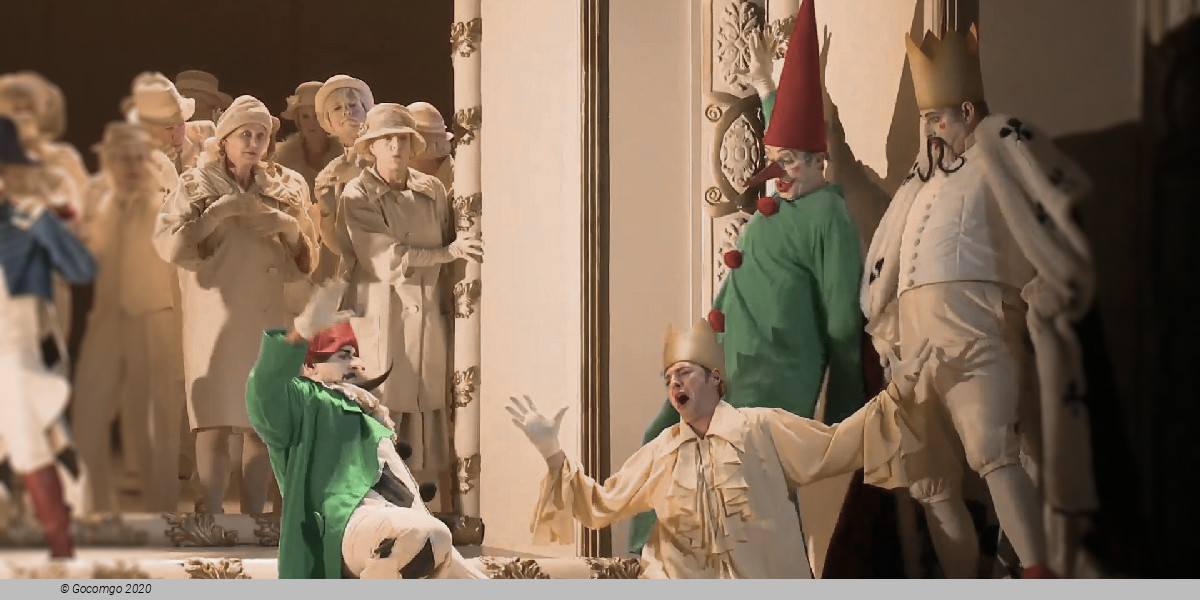
All efforts to make the Prince laugh fail, despite the urgings of the supporters of Comedy, until Fata Morgana is knocked over by Truffaldino and falls down, revealing her underclothes—the Prince laughs, as do all the others except for Leandro and Clarice. Fata Morgana curses him: henceforth, he will be obsessed by a "love for three oranges". At once, the Prince and Truffaldino march off to seek them.
Act 3
Tchelio tells the Prince and Truffaldino where the three oranges are, but warns them that they must have water available when the oranges are opened. He also gives Truffaldino a magic ribbon with which to seduce the giant (female) Cook (a bass voice) who guards the oranges in the palace of the witch Creonte.
They are blown to the palace with the aid of winds created by the demon Farfarello, who has been summoned by Tchelio. Using the ribbon to distract the Cook, they grab the oranges and carry them into the surrounding desert.
While the Prince sleeps, Truffaldino opens two of the oranges. Fairy princesses emerge but quickly die of thirst. The Ridicules give the Prince water to save the third princess, Ninette. The Prince and Ninette fall in love. Several soldiers conveniently appear, and the Prince orders them to bury the two dead princesses. He leaves to seek clothing for Ninette so he can take her home to marry her, but, while he is gone, Fata Morgana transforms Ninette into a giant rat and substitutes Smeraldina in disguise.
Act 4
Everyone returns to the King's palace, where the Prince is now forced to prepare to marry Smeraldina. Tchelio and Fata Morgana meet, each accusing the other of cheating, but the Ridicules intervene and spirit the witch away, leaving the field clear for Tchelio. While Leandro and the Master of Ceremonies see that the palace is prepared for the wedding, Tchelio restores Ninette to her natural form. The plotters are sentenced to die but Fata Morgana helps them escape through a trapdoor, and the opera ends with everyone praising the Prince and his bride.













 Teatralnaya Square 1